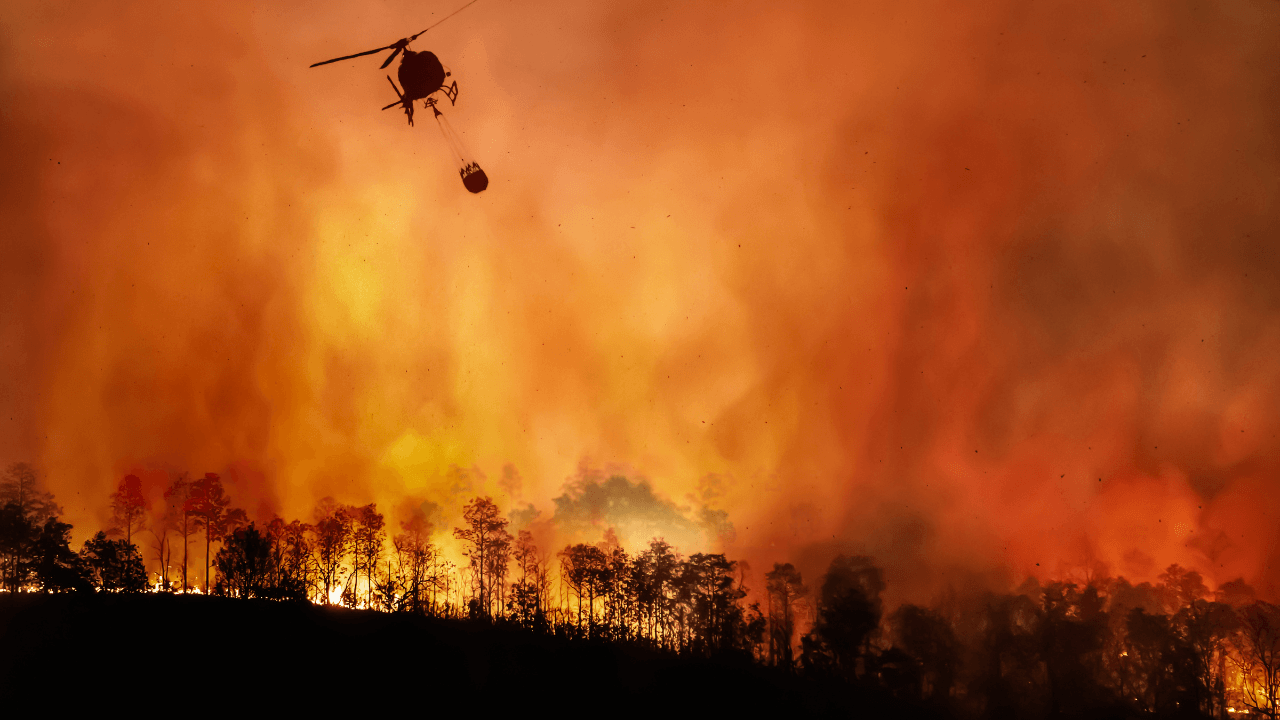
It is not just your imagination. Over the last ten years, major natural disasters have increased in force and frequency.[1] Whether a hurricane in North Carolina, floods in Texas, wildfires in California or devastating heatwaves in the Eastern U.S., disaster preparedness is increasingly important. And the key to keeping people safe is good communication.
When the power goes out, your phone shows no bars, and you’re standing in the dark wondering what’s actually happening outside, knowing where to turn for information is critical.
Take the following story as an example: On Good Friday in 1964, the ground shook Anchorage Alaska for approximately four and a half minutes, which is still the strongest earthquake ever recorded in North America. A part-time radio reporter named Genie Chance was working for KENI, a local AM station. The quake knocked KENI off the air, and when it came back, she cut in from the two-way radio in her car and started talking. She broadcast for roughly thirty hours, telling people how to purify snow for drinking water, relaying hospital requests for supplies, and passing messages between families trying to find each other. The police chief effectively made her the city’s public information officer.[2]
And now, six decades later, when the power goes out and the cell towers go quiet, radio is still the thing that keeps working.
We’ve been trained to believe our phones are the ultimate lifeline in an emergency. So why does disaster after disaster keep proving that wrong?
When every other system went quiet
Take Hurricane Helene. When it tore through Western North Carolina in September 2024, iHeartMedia’s WWNC in Asheville broke from its usual talk format to become a round-the-clock lifeline for the community. Fallen trees trapped the station’s own staff inside the studio, with limited power, water and phone reception. Morning anchor Mark Starling put it plainly: radio was “the only medium that was left” able to reach people.[3]
Six months later, that station was still the voice people leaned on for recovery information.
When the alerts came a day late
When wildfires tore through Los Angeles County last year, officials leaned on cell phone alerts to warn people to evacuate. Unfortunately, cell towers went down and came back online with cached warnings that went out a day late. Some alerts didn’t say where the danger actually was, just that residents were “in the area.”
The same pattern showed up again in July 2025, when flash floods struck Kerr County, Texas, and more than a hundred people died after emergency alerts reportedly reached some residents hours after the water had already risen.[4]
None of this means cell alerts are useless. But they need a functioning cell tower, a charged phone and a signal that isn’t overwhelmed by everyone else in the neighborhood trying to call for help at once. Broadcast radio serves as a complementary emergency alerting system because it doesn’t have the same congestion problem — broadcast towers are built to keep running through a disaster, often with generator backup, so stations can keep broadcasting no matter what else is happening around them.
What HD Radio emergency alerts actually do
Here’s where I’ll put my Xperi hat on for a minute, and talk about our HD Radio technology, because this is the part of the story I know best. HD Radio is a digital signal that rides alongside a station’s existing AM or FM broadcast, over the air, free, no subscription and no internet connection required. The digital layer simply adds capacity for things analog never could carry: additional channels riding on the same frequency. In fact, many of you may have this capability as the owner of one of the more than 125 million vehicles on the road in North America that have HD Radio in the dash.
HD Radio can push a written alert straight to a compatible receiver and in addition to geographical targeting, it can also carry the same alert in more than one language at once: for example, an English broadcast on a station’s main HD1 channel, with the identical alert translated in Spanish on an HD2 or HD3 subchannel. And some HD Radio-enabled receivers can wake themselves up from standby when a high-priority alert comes through.
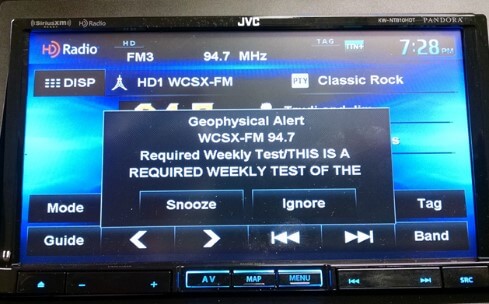
Is this theoretical? Not even a little. The Florida Public Radio Emergency Network already uses HD Radio audio and data pipelines during hurricanes to push real-time evacuation routes and shelter updates directly to dashboard displays. When cellular networks buckle under the weight of a storm, Florida drivers can stay informed through their radios.[5]
And this isn’t some future promise, either. As of February 2026, roughly 60% of new cars shipped in the U.S. now come pre-equipped with HD Radio receivers.[6] That’s not a technology waiting to be built. It’s already sitting in most driveways.
And none of this requires new infrastructure to be invented. Upgrading an existing station to carry this kind of alert can be done within a year, at a fraction of what it costs to extend other types of infrastructure into the same rural and urban areas. And, unlike fiber, satellite or cellular service, it keeps working in exactly the places and moments where other systems are most likely to fail.[7]
According to the National Association of Broadcasters, 77 AM radio stations across the country are designated Primary Entry Point stations, built to receive emergency alerts directly from FEMA and the National Weather Service, with signals reaching roughly 90% of the U.S. population.[8]
Programs built to fund resilient, rural infrastructure are looking for exactly this kind of reliability: something that keeps operating when other services can’t. Broadcast radio already clears that bar and has for decades. The opportunity now is in what a digital signal adds on top of it, delivered over the same towers that have been quietly doing this work all along.
The signal that never went out of style
This is not to argue against smartphones in an emergency, they play a vital role; but to stress the one thing that has already proven itself, time and time again, that is trusted and keeps working when everything else stops: radio. And it is only getting better at the job.
The next time the ground shakes, or the sky turns an ominous color, or the water starts rising faster than anyone expected, the radio in the car or on the nightstand doesn’t need a signal bar to find people. It just needs to be on.
[1] https://usafacts.org/articles/are-the-number-of-major-natural-disasters-increasing/
[2] Jon Mooallem, This Is Chance!: The Shaking of an All-American City, a Voice That Held It Together (Random House, 2020); excerpt published as «When a Quake Shook Alaska, a Radio Reporter Led the Public Through the Devastating Crisis,» Smithsonian Magazine, March 19, 2020. Earthquake duration and magnitude per U.S. Geological Survey.
[3] Inside Radio, “How One Asheville, N.C. Station Became a Listener Lifeline During Helene,” 2024.
[4] Reporting on the July 2025 Kerr County, Texas floods, including coverage from KUT, NBC DFW, and the Texas Tribune; death toll figures varied slightly by outlet and by date reported.
[5] Xperi Inc., “Upgrading the Emergency Alert System: HD Radio Digital Emergency Alerting,” white paper, describing the Florida Public Radio Emergency Network (FPREN)
[6] Xperi Inc., «Digital Information Safety Net: Enhancing Public Access Through Next-Generation Digital Broadcast Radio,» white paper, February 18, 2026.
[7] Cost and deployment figures from Xperi Inc., “Digital Information Safety Net” white paper, February 18, 2026.
[8] National Association of Broadcasters, AM Toolkit, “Why Depend on AM,” nab.org/amtoolkit/amEas.asp